
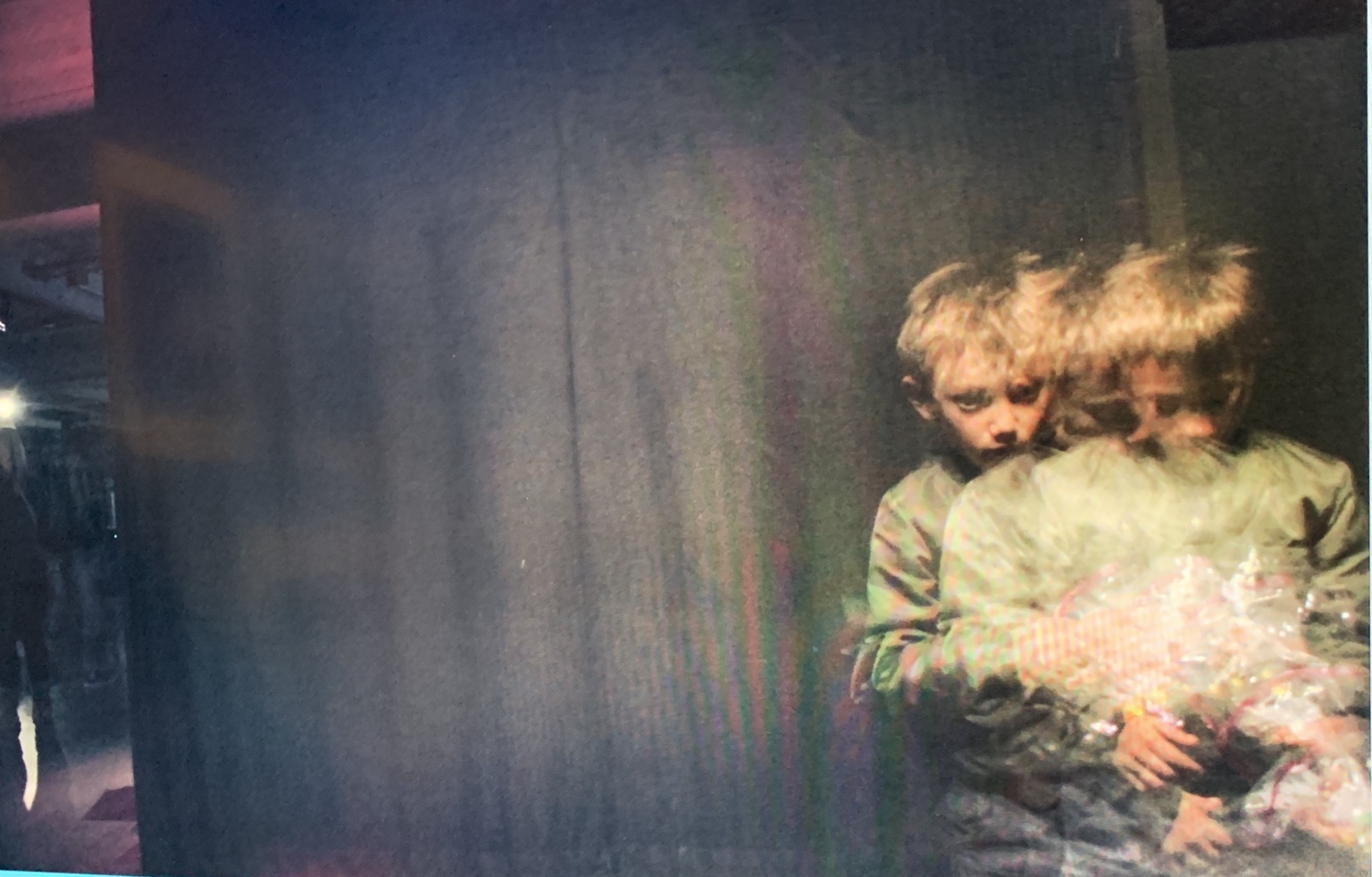
Ordinary life deserves better software.
Not more of it. Software that actually carries some of the load.
The kind that understands that a family is a system. A home is a system. Health is a system. School, work, money, memory, time, care, and responsibility all overlap, change, interrupt one another, and depend on people remembering what happened yesterday while trying to figure out what matters next.
Most of us still hold that complexity together with calendars, screenshots, text messages, notes apps, folders, browser tabs, pieces of paper, and our own memory.
And usually, somewhere inside that system, there is one person carrying far more of it in their head than anyone realizes.
That is the territory I keep coming back to. Nomos Industries is the company I am building around it.
The name comes from the idea of order. Not rigid order, but structure that helps make complexity understandable.
Our internal phrase is simple:
order from complexity.
Ten years across a desk
I did not spend a decade at a famous technology company. I spent it across a desk from thousands of people, asking them what had happened, what they needed, what they had already tried, and what was standing in the way.
For almost ten years I was an eligibility worker in San Francisco. I interviewed people applying for food assistance and Medi-Cal. Parents. Grandparents. Young adults. People who had lost jobs. People navigating illness. People escaping unsafe situations. People who were homeless. People rebuilding their lives.
People from almost every background imaginable, often meeting government systems during one of the most vulnerable periods of their lives.
For nearly three of those years I worked in outreach at the Community Assessment and Services Center, interviewing people on probation and parole. Some had just come home after years, sometimes decades, of incarceration. In a number of cases, I was one of the first people they sat down with who was not a police officer, a correctional officer, or a probation officer.
The interviews were supposed to determine eligibility. A lot of them ran for hours. People would tell me things that had nothing to do with the form, because the form was never really the point.
You learn a lot about systems when your job is listening to the people who have to survive inside them.
You learn where forms stop making sense. Where instructions assume knowledge people do not have. Where one missing document can derail an entire process. Where someone can technically qualify for help and still be unable to access it.
You learn where language, shame, fear, bureaucracy, technology, and exhaustion pile on top of a problem that was already difficult.
You also learn that people are far more complicated, funny, resilient, frustrating, capable, vulnerable, and interesting than any demographic profile could ever capture.
I have stories. A lot of them. And they changed the way I think about people and systems long before I ever thought of myself as someone who might build technology.
It is not the traditional founder biography. Looking back, I cannot imagine better training for the kinds of systems I want to build now.
These are not abstract users
The mother trying to remember which child had which symptom three weeks ago.
The teenager who is not incapable of doing the work, but cannot figure out how to organize everything long enough to begin.
The person working in the field who knows exactly how to do the job but spends too much of the day fighting the systems surrounding it.
The family trying to keep appointments, school messages, forms, medications, repairs, bills, responsibilities, and life itself from falling through the cracks.
These are not abstract users to me. They are people I know.
If I have a question about one of these problems, I can call forty people who have lived some version of it. And in many cases, I do not even have to call anyone. I have lived it.
That is one of the funny things about the companies I am building. I usually start because I need the thing. I am trying to solve some irritating, repetitive, ordinary problem in my own life. Then I look around and realize ten people I know have the same problem. Then a hundred people online are talking about it. Then I start wondering whether the little thing I built for myself might actually be a company.
I know what it feels like to navigate systems that were not designed for you. I know what it feels like when the information technically exists somewhere, but the system still leaves you responsible for finding it, understanding it, remembering it, translating it, and acting on it.
I know how quickly one forgotten thing can become five more things. And I know how exhausting it is to keep reopening the same mental loop because something has not been resolved.
That is the class of problem I want to work on. Not because it is small. Because it is everywhere.
A different starting point
I did not start with companies, developers, productivity, or automation. Those things matter. But they are not where I started.
I started with the smallest problem I could understand deeply, for the person I knew best. Me. Then my family. Then the people around me. And then the thousands of people I watch, listen to, and interact with online who keep describing different versions of the same kinds of problems.
I am also raising four children across three generations. Gen Z, Gen Alpha, and Gen Beta.
Which is a slightly ridiculous sentence to write, but it matters.
I am watching, in real time, how different generations encounter technology, education, attention, communication, responsibility, and the world around them. I have teenagers who grew up with smartphones already everywhere. I have younger children who will grow up assuming artificial intelligence is simply part of the environment.
And I am standing somewhere in the middle, old enough to remember life before all of it, while building for what comes next.
That perspective finds its way into the work.

One thesis · different doors
The products are different. The promise underneath them is not.
Acesa
Family health memory + intelligence
MUNUS
Planning + study support for teenagers
Kehai
Personal body signals
From the outside this can look like a lot of different things. Family systems, health tools, planning tools, tools for tradespeople, tools for creators, tools for understanding time.
I understand why someone might look at the portfolio and ask why so many.
I do not experience them as separate ideas. They are doors into the same room.
I am not building a random collection of apps. I am building a company around a recurring class of problem. The portfolio may be broad, but the work ahead is focused: choose the strongest entry points, take them deep, and prove that the underlying system works.
A family with young children needs one kind of system. A teenager learning to manage school and responsibility needs another. Someone running a crew in the field needs another. Someone trying to understand where their days are actually going needs another.
The interface changes. The underlying question rarely does:
How can the system carry more of the complexity so the person can carry less?
A backlog finally being released
Some of these ideas have been in my head for years. A few of them, in some form, for more than a decade.
I wish I could say I started building the first one fifteen years ago. I could not. I did not have the technical education. I did not have access to engineers. I did not have venture capital. I did not know how to turn what I could see in my head into software.
For most of my life, having the idea and being able to build the idea were two completely different things.
Artificial intelligence changed the distance between them.
But I want to be careful about how I describe that, because there is a version of this story going around that I do not think is true.
It did not make building easy. It made it possible for me to start.
Four months in, I understand what engineers are paid for. An app is not a screen with buttons on it. It is data you are responsible for. Decisions that are hard to reverse. State that has to be right when someone is tired and in a hurry. Security. Privacy. What happens when the network drops. What happens when the person is wrong. What happens when the person is a child.
These are systems that touch health, family, school, money, and work. Every screen is a decision, and the decisions have to be intentional, because I am not making a demo. I am building a company.
The distance closed. The work did not get smaller.
The resource I want to return
The resource I am ultimately trying to give back is the most valuable resource any of us have: time.
Time with your family. Time to think about something else. Time to work on the thing you actually care about.
Time that is not spent searching through an inbox, recreating information you already gave someone, or reopening the same unfinished loop because you cannot remember whether the appointment, form, message, or repair was handled.
That is what I want intelligent software to do. Not demand more of our attention. Return some of it.
A little attention. A little clarity. A little memory. A little breathing room. And, when we do it well, a little time.
And if this technology is really going to become part of everyday life, then it needs to be understandable by everyday people.
That means plain English. It means an interface that does not make someone feel stupid because they do not know the language of software. It means intelligence that can explain what it is doing. It means privacy, consent, reversibility, and the ability to say no.
And it means making something people actually want to pick up and use. I care enormously about that last part.
Useful software does not have to feel clinical, institutional, or cold. The systems underneath these products can be incredibly complex. The experience should not be. The goal is for the complexity to disappear behind something calm, thoughtful, understandable, and human.
The next phase is depth
The ideas are no longer the scarce resource.
The work now is depth. Reliability. Security. Infrastructure. Testing. Distribution. Choosing where to focus and making the strongest systems genuinely useful in people's lives.
I am not interested in building technology simply because we can. I am interested in building technology that earns its place in someone's life.
Technology that understands when to help and when to stay quiet. Technology that makes a complicated thing feel a little more manageable. Technology that turns information into understanding.
That is what I am building. That is Nomos.
If you read all of this
Then you are the person I wrote it for.
I am not hard to find. If my story sounds interesting and you want to talk, reach out. If you are an investor, a mentor, or the kind of person who can spot a unicorn before the horn comes in, I want to hear from you.
If you are an engineer and could become as passionate about this work as I am, I wrote a separate page about the stack, the architecture, and what I actually need. Work with me →
Buy me a coffee and tell me I am wrong about something. That works too.