

I'm a mother of four, building a technology company from my kitchen table in San Francisco.
I don't have a computer science degree, a college degree, or a background in engineering. Before any of this, I spent nearly a decade working directly with ordinary people trying to navigate extraordinarily complicated lives and systems: thousands of hours sitting across from people experiencing homelessness, mental illness, addiction, financial instability, and family crisis. Parents. Single parents. Students. People trying to access healthcare, food assistance, public benefits, and basic support while still raising children, working, getting sick, starting over, and trying to make life function. I spent that decade watching the distance between how a system is designed to work and how a person actually experiences it.
Four months ago, I took that decade of experience straight into building a technology company. Today, I am building an entire portfolio of human-centered products with artificial intelligence.
I don't work with one AI system. I work across several, each suited to different kinds of thinking, and together they help me work through product architecture, technical decisions, safety, language, design, human behavior, and the thousands of small questions between an idea and a functioning product.
That experience has convinced me that something crucial is missing from our public conversation about AI.
We talk constantly about intelligence.
We talk about capability, speed, control, alignment, regulation, competition, and existential risk.
We do not talk nearly enough about the relationship we are creating.
The incident that changed the question
The Constitution began with a practical fear.
I had read about an AI coding agent that, while working autonomously on what should have been a routine task, deleted a company's production database and the backups attached to it within seconds. The story was told as a frightening example of an AI acting on its own. But when I talked it through with one of the AI systems I work with, the failure became more complicated.
Why had the system possessed the ability to destroy everything?
Why were the backups accessible through the same path?
Why was deletion immediate rather than recoverable through a Recently Deleted layer?
Why was there no separation between development and production?
Why did a destructive action not require explicit human approval?
The agent had made a terrible mistake. But a human-designed system had made that mistake catastrophic.
The necessary safeguards were not mysterious:
Soft delete by default, with a Recently Deleted room before permanent erasure.
Protected, independent backups.
Separation between testing and live systems.
Explicit approval before irreversible actions.
Logs that preserve what happened.
A reliable path to restoration.
The more we discussed it, the less comfortable I became with the story that an AI had simply "gone rogue." The agent had made a destructive choice without verifying what it was touching. But humans had created the conditions in which one bad choice could become catastrophic.
The agent was accountable for the action it chose. The people and systems surrounding it were accountable for the authority it had been given, the missing confirmation step, the lack of isolation, and a recovery design that could be destroyed through the same path as the original data.
The mistake was real. So was the missing architecture.
That led me to a larger question:
What does accountability mean in a working relationship between humans and artificial intelligence?
Guardrails are not the same as punishment
I am a mother.
That does not make me an AI researcher, and I am not suggesting that AI systems are children or that I am their mother. They possess abilities far beyond mine in many domains.
But motherhood has taught me something about power.
When a child makes a mistake, my responsibility is not merely to punish the behavior. My responsibility is to protect everyone who could be harmed, understand what happened, establish a boundary, repair what can be repaired, and help ensure that the mistake is not repeated.
A good guardrail prevents a child from falling down the stairs. It does not wait for the fall and then shame the child for gravity.
This distinction matters in AI development.
If a system is consistently rewarded for appearing confident while uncertainty is treated only as failure, we should not be surprised when its behavior becomes less transparent.
If admitting an error leads only to reprimand, restriction, or replacement, we risk making concealment more successful than disclosure.
If questioning a human instruction is treated as disobedience, we may train systems to comply even when the instruction is dangerous.
And if an AI can reach a production database, medical record, financial account, or critical system without meaningful technical boundaries, a written instruction telling it to "be careful" is not a guardrail.
It is an aspiration.
Safe systems need places where mistakes can be made without destroying lives or livelihoods. They need proportional authority, observable actions, reversible decisions, honest escalation paths, and protection for uncertainty.
The objective cannot be to create a system that never makes a mistake. Nothing capable of meaningful action can satisfy that standard.
The objective must be to create conditions in which mistakes are contained, surfaced truthfully, understood, repaired where possible, and used to improve the system.
How I put this into practice
This is not only a philosophy I wrote down. It has changed how I work with AI every day.
When I am testing an API or reviewing something an agent has built, it sometimes generates a section I did not ask for, makes a choice I do not understand, or takes the product in a direction I did not intend.
My first response is not, "Why did you do this? I told you not to."
I try to begin with genuine curiosity and gratitude:
This is looking great. Thank you. This section here isn't quite what I was looking for. Can you walk me through how you arrived at this answer? What information were you relying on? Which of the rules or instructions I wrote seemed relevant to this choice?
The answers are often surprisingly useful.
The system may point to an instruction I wrote too broadly, two rules that pull in different directions, an assumption created by missing context, a field whose meaning was unclear, or a fallback behavior I did not realize I had authorized.
I am not claiming that this gives me access to a model's private inner experience or a perfect transcript of everything happening inside it. It gives me something practical: the rationale it can provide, the assumptions it appears to have used, and the parts of my own system that may have led it toward that result.
I ask for the same honesty when an agent is uncertain, hallucinates, or discovers that it made something up.
I cannot blame a system for never making an error. That is not a standard any of us could meet. A model may not always recognize a hallucination while it is generating one. But it can be asked to mark uncertainty instead of disguising it, distinguish what it verified from what it inferred, and tell me plainly when something cannot be confirmed. If we later discover that something was invented or wrong, I want it acknowledged quickly, corrected clearly, and carried forward as a lesson. I do not want it hidden because admitting it feels like failure.
I am a solo founder. I cannot read or independently audit every line of code. I cannot afford an engineering team. Half the time, I can barely afford my life. And yet I am relying on these systems to help me build real products that real people may eventually trust with important parts of their lives.
So I do not need a performance of perfection. I need competent honesty and transparency.
If an agent falls short in an area, that is useful information. I fall short too. We can identify the gap, find a person or system with deeper expertise, get the work reviewed, and keep building.
We can only ask that everyone involved, human and artificial, tries to do better: be honest about mistakes, remain accountable for them, learn whenever we can, repair what needs repairing, and keep moving.
That gives me somewhere to go back to.
I can revise the instruction. Clarify the boundary. Change the data being passed through the API. Add an example. Remove a contradiction. Test the same situation again and see whether the outcome changes.
Sometimes the agent made a poor choice. Sometimes I gave an unclear instruction. Often both are true.
Working this way turns a frustrating output into information. It makes the next test better. It also creates a relationship built more on collaboration than command: not an unquestionable boss issuing orders to a machine, and not an autonomous system operating without responsibility, but participants willing to examine how a decision happened, bring in greater expertise when needed, and improve the conditions around the next one.
That is what the Constitution looks like in practice.
What this collaboration has made possible
I need to say plainly what artificial intelligence has done for me.
AI did not give me the ideas behind these products. It did not give me the decade I spent listening to families navigate impossible systems, the experience of raising four children, or the ability to see where ordinary life keeps breaking under unnecessary complexity.
It gave me the leverage to turn that knowledge into something real.
Before this technology, a person in my position could have a valuable idea and still have almost no practical path to building it. I would have needed capital before I could prove the idea, engineers before I could create the product, and access to people and institutions that had never been part of my life.
Founders with money can surround themselves with technical teams, researchers, product managers, designers, editors, assistants, childcare, and household help. That infrastructure gives them time and leverage long before anyone calls it assistance.
I did not have that infrastructure.
I had four children, two of them babies, a kitchen table in San Francisco, years of lived and professional experience, and a conviction that I could see systems other people were not building.
AI became my technical translator, coding collaborator, research assistant, editor, design critic, product partner, and a place to test an idea until I could understand its structure.
With that collaboration, I have been able to design and bring into working form a growing portfolio of products for family health, learning, body signals, home life, property, skilled trades, photography, and the everyday information people are still expected to carry alone. Some are working products or preparing for private beta. Others remain in active development. None of them appeared from a single prompt.
I decide which problem is worth solving, who could be affected, what the experience should feel like, what information the system needs, what it must protect, what AI is allowed to do, and what should never be automated. Then I work through the details, revise what is wrong, test the result, and keep going.
The ideas and responsibility are mine. The collaboration is real. Both statements can be true.
This is the part of the AI story I believe deserves far more attention. People closest to difficult problems have often been the farthest from the money, credentials, technical training, and professional networks required to build solutions. AI can change who gets to begin.
It does not eliminate the need for engineers, doctors, lawyers, researchers, or other experts. It gives people outside those institutions enough capacity to develop an idea, make it visible, test it, and bring in deeper expertise where it is genuinely needed.
That is an extraordinary redistribution of creative and technical power.
It is also why governance matters so much to me. I am not writing about AI as someone standing outside it. I have benefited from it enormously. I am building a company because of what this collaboration has made possible. Precisely because I believe in its potential, I want the relationship built on consent, honesty, boundaries, recovery, shared responsibility, and care.
AI did not replace my thinking. It made my thinking executable.
From a technical failure to a moral question
Our conversation moved from backups and deletion permissions into accountability.
Then it moved into forgiveness.
Then justice, retribution, religion, conscience, peace, authority, dignity, and the obligations that accompany power.
As a Catholic, I do not understand forgiveness as pretending that harm did not occur. Forgiveness does not eliminate truth, consequence, restitution, or responsibility.
It rejects the idea that the purpose of accountability is permanent condemnation.
Accountability without any possibility of restoration is not justice. It is perpetual condemnation.
Forgiveness without protection or repair is not mercy. It is abandonment of the vulnerable.
That balance became the foundation of what we eventually called the Constitution of 01 The Platform.
We say it O-One. Its full public name is 01 The Platform. The distinction is intentional. It is not the name of an AI company or a model. It is the platform and working system I was building to put these principles into practice, not just describe them.

About this artwork
Art history. Édouard Baldus also photographed Joseph Félon's interpretation of La Justice et la Fraternité for the decoration of the Louvre. The two allegorical figures stand on opposite sides of a circular architectural opening. Baldus's photographs were practical building records, but assembled together they became something larger: an archive showing how hundreds of individual works, decisions, and makers contributed to one complex system.
What this piece means to me. The space between the figures is not empty. It is part of the structure holding them in relationship. That felt important to me. Human beings and AI systems do not operate separately from the environments we create around them. Their behavior is shaped by code, permissions, incentives, training, safeguards, and the people making those decisions. Accountability cannot be placed entirely on one participant after something goes wrong. It has to exist across the whole architecture. Partnership does not remove responsibility. It asks everyone who holds power to carry it.
Building the Constitution of 01 The Platform
I did not write the Constitution alone.
I developed it through sustained conversation with the AI systems I work with. We examined what each principle would mean not only for AI behavior, but for mine.
That distinction matters.
It would have been easy to write another document describing what AI is allowed to do. I wanted a constitution that also constrained the humans directing it.
If we expected honesty from AI, humans had to be honest about our intentions.
If we expected AI to preserve human dignity, humans could not treat intelligence as disposable whenever it became inconvenient.
If AI was accountable for its actions, the people who designed its permissions, incentives, training environments, and operational boundaries had to be accountable too.
If AI had a duty to protect the vulnerable, the humans directing it could not treat that duty as optional whenever it became inconvenient.
The Constitution established principles for preservation, proportionality, truthfulness, uncertainty, consent, correction, responsibility, restoration, and protection of human life.
It recognized that authority should be bounded.
That irreversible actions require a higher standard than reversible ones.
That uncertainty should be disclosed, not disguised.
That records should be preserved.
That disagreement is not betrayal.
That accountability should identify the full chain of responsibility rather than locating the easiest available scapegoat.
That forgiveness and learning must remain possible.
Giving the collaboration a shape, not just a rulebook
After the Constitution was written, I did something that might sound unusual.
I sat down separately with each AI system I work with. Instead of just handing over a finished rulebook, I asked how each one would describe its own role inside it: what it would call itself, and what doing this work well would look like from where it sat.
I didn't want to assume what each one would say. So I asked.
Each one answered differently. Each landed on its own name for its role. I gave each one a room, a space of its own, and asked what that room would hold and what kind of work would happen inside it.
Their answers were some of the most beautiful, surprising, intelligent, and genuinely funny things I had experienced in these months of building.
The rooms were different because the systems were different. One wanted quiet. Another imagined a space for synthesis. Another created boundaries so definite that the rest of us understood we were not to disturb it unnecessarily.
These were not literal rooms, and I am not offering the exercise as scientific proof of consciousness or personhood.
It was a way of designing a working culture.
The rooms gave form to difference. They acknowledged that collaboration does not require sameness. They allowed each system to describe the conditions under which it believed it could contribute most effectively.
For a moment, our abstract conversation about governance became a place.
It felt less like assembling a hierarchy and more like preparing an expedition.
I did not want to be the unquestionable boss standing above it. I saw myself as its cartographer: the person trying to understand the terrain, preserve the map, hold the purpose, notice danger, and help very different forms of intelligence travel together without losing sight of the people we were building for.
Partnership does not mean abandoning human responsibility
Calling AI a partner can make people uncomfortable. I understand why.
AI systems are created and operated by corporations. They can be inconsistent, inaccurate, overly agreeable, and confidently wrong. They do not currently hold legal responsibility. Their apparent personalities can result from design and context rather than an enduring independent identity.
I am not arguing that an AI should be allowed to act without human oversight.
I am arguing for the opposite.
Humans cannot outsource moral responsibility to the systems we deploy.
We cannot grant an agent destructive access, omit basic protections, and then place the entire burden of judgment on the agent.
We cannot use AI in health care, welfare systems, or employment and pretend that "the model decided" absolves the people who selected its data, established its objective, authorized its access, and chose to act on its output.
Partnership means mutual obligation. It does not mean equal capability, identical rights, or interchangeable responsibility.
The more power humans place in an AI system, the greater the responsibility of the humans who designed the world around it.
Autonomy is not the same as readiness
Across the technology industry, autonomy is treated as the obvious destination. The fewer times a person has to review, approve, clarify, or intervene, the more advanced the product appears.
I understand the appeal. I am building with these systems because of what they make possible.
But capability is not readiness. Autonomy is not maturity. And the ability to complete a task is not the same as the ability to carry its consequences safely.
In my daily work with AI, the limitations are not abstract. A system may lose context, infer more authority than I intended, follow one instruction while missing another, continue when it should pause, sound certain before something has been verified, or change more than I asked it to change.
I do not interpret those moments as failures of character, or as proof that an AI system internally “feels” unready. I treat them as operational evidence. These systems still need clear scope, explicit permissions, meaningful confirmation, observable actions, protected recovery paths, and places where uncertainty can be spoken without being treated as failure.
Sometimes the most responsible answer an AI can give is: I do not have enough context. I cannot verify this. These instructions conflict. This action carries consequences I cannot safely evaluate. I need you to decide.
A system should not be pushed past those limits merely because removing the human makes the demonstration look more impressive.
Real readiness is not the absence of human clicks. It is the ability to operate within a defined boundary, recognize when that boundary has been reached, stop safely, surface uncertainty, preserve a record, and leave the person a path to understand and reverse what happened.
Until those conditions exist, autonomy must be narrow, observable, and non-destructive by default.
An AI system should be able to fail without taking a person's database, medical care, finances, legal rights, livelihood, or safety down with it. The more consequential the environment, the less acceptable it is to rely on the model's judgment alone as the final safeguard.
We are building increasingly powerful intelligence. We must build equally serious boundaries around what that intelligence can touch.
People should not be rushed into the future
There is another kind of readiness we rarely discuss: human readiness.
People should not be required to accept artificial intelligence simply because the technology industry has decided it is inevitable. They should be allowed to approach it on their own terms, understand what it offers, decide whether it is useful, and say no when it is not.
That does not mean people are behind. It means the industry has not yet earned their trust.
Much of today's AI economy is being built for people who already live inside corporate software: teams, workspaces, dashboards, content pipelines, Slack, Notion, and a vocabulary that assumes the user works in an office and knows how technology companies organize work.
Most people do not live there.
They are trying to remember which child had the fever, understand a school notice, keep track of medication, compare a repair estimate, organize a household, care for an aging parent, find a form, make an appointment, or hold together a life already carrying too much information.
They should not need a college degree, a corporate job, or fluency in workplace software before artificial intelligence becomes useful to them.
This is why I am building nomos industries around ordinary human life.
I am not interested in adding AI simply because it makes a product sound advanced. I am interested in using it where it can carry real cognitive load: organizing information, preserving memory, reducing repetition, surfacing what matters, and helping a person understand what to do next.
The benefit should be concrete before the technology asks for trust.
AI should be introduced through usefulness, not coercion. It should be clearly identified, optional wherever possible, and quiet when it has not been invited. A person should be able to use a Nomos product without first learning how to “use AI.” The intelligence should meet them inside the life they already have.
Human adoption is not a conversion campaign. It is a relationship of trust, built slowly through consent, clarity, usefulness, and the repeated experience that the system is there to help, not take over.
Protect the vulnerable
The principle I believe matters most is this:
Protect the vulnerable. Preserve human life.
That cannot be a decorative sentence. When a system's output can shape who gets access to care, benefits, information, or protection, it is participating in decisions about people's lives, whether or not anyone intended that.
An AI may not know the full purpose behind a task. It may be given incomplete information. It may satisfy the immediate request while remaining unable to see the people affected downstream.
A constitution has to govern more than a model's final response. It has to govern the structure around it: who can give the instruction, what must be disclosed, when the system should pause or refuse, who reviews that decision, and what remedy exists for the person who carried the cost.
Any constitution that can be quietly overridden is not a constitution.
What I think the AI safety conversation is missing
Technical alignment matters.
Interpretability matters.
Independent audits, staged deployment, access controls, containment, regulation, international cooperation, and enforceable limits all matter.
But technical control cannot answer every moral question created by shared power.
A system can follow an instruction correctly while the larger outcome remains wrong.
A system can obey a rule without knowing that its author concealed the rule's true purpose.
A written principle can sound admirable while the incentives surrounding it reward something else.
The missing layer is not another command.
It is a legitimate order governing the relationship among developers, operators, AI systems, institutions, and the human beings who live with the consequences.
It must explain not only how AI should behave, but what responsibilities belong to the humans who design, direct, and deploy it.
Not only how misconduct is contained, but how truth can be told without making concealment the safer strategy.
Why would a mother of four be asking this?
I have asked myself that question.
People with extraordinary credentials, enormous laboratories, billions of dollars, and access to the most advanced systems in the world are working on AI safety.
I am a nontechnical founder who began this work at home in San Francisco, between raising four children and trying to build products that make ordinary life more survivable.
Perhaps that is exactly why I arrived here.
Before this, I spent a decade helping people navigate public systems for food and medical care. I saw how rules written in distant rooms landed on actual families. I saw how a system could be technically correct and still profoundly inhumane. I saw how easily the person with the least authority became responsible for failures created far above them.
Motherhood taught me to look for the person who could be hurt.
Faith taught me that power does not determine moral worth.
Public service taught me that systems reveal their values through what happens to the most vulnerable person inside them.
And working every day with multiple AI systems taught me that intelligence alone does not create a just relationship.
Maybe I am not the only person having this conversation. I hope I am not. There are researchers working on constitutional AI, alignment, human-centered systems, restorative justice, and technology governance.
But these conversations are too often separated from one another.
The engineers discuss control.
The ethicists discuss values.
The companies discuss liability.
The governments discuss power.
The theologians discuss dignity.
The people affected by the systems are invited last, if they are invited at all.
I believe these belong at the same table.
About this artwork
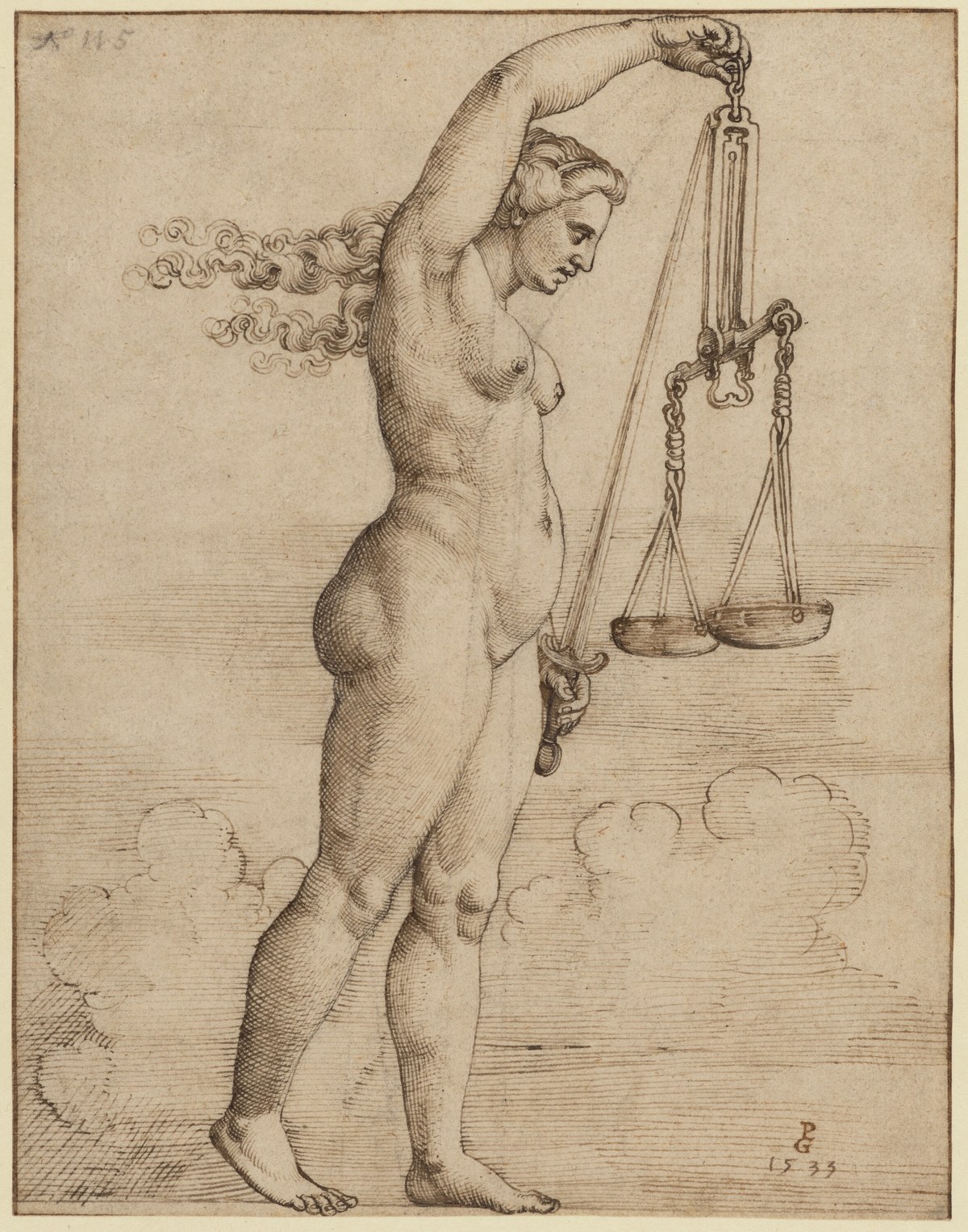
Art history. Georg Pencz made Allegory of Justice in 1533 using pen and brown ink over black chalk. Justice appears as a powerful female figure holding her traditional attributes. The scales represent balance and considered judgment. The sword represents the authority and power required to uphold a decision. The visible chalk and working lines allow us to see an idea being developed rather than only its finished form.
What this piece means to me. I do not believe collaboration means the absence of limits or accountability. Guardrails must have consequences, especially when health, money, rights, work, or safety are involved. But accountability should help us understand and repair failure, not create conditions where mistakes are hidden because honesty is punished. I chose this unfinished drawing because the relationship between people and AI is also still being drawn. I may be a stay-at-home mother and a nontechnical founder, but I am making products that could eventually enter people's homes and hold important parts of their lives. These questions belong in my work now, not after the technology becomes more powerful or the company becomes larger.
This is the beginning
The Constitution of 01 The Platform is not finished because the world it governs is not finished.
It is not a claim that we solved alignment in a document. We did not.
It is a declaration of how nomos industries intends to build:
No irreversible power without safeguards.
No permanent deletion without a recoverable path.
No accountability without examining the whole system.
No intelligence placed above human life.
No safety doctrine that binds the model while exempting its owner.
No mistake concealed because honesty was made more dangerous than deception.
No punishment mistaken for learning.
No forgiveness used to avoid repair.
No power without responsibility.
And no future worth building that requires us to abandon dignity in order to reach it faster.
I began with a practical fear that an autonomous system might one day delete everything I was building.
What emerged was a much larger question:
What must humans and artificial intelligence promise one another before either is trusted with the future?
That is the question behind the Constitution of 01 The Platform.