
I recently sent someone the longest text message I have ever sent anyone. 🙈
It was so long that my iPhone stopped displaying it like a normal text and collapsed the whole thing into a separate, document-like view.
Somewhere around paragraph seventeen, I realized Apple may have had a point.
My phone was basically telling me, ma'am, this is no longer a text message.
The message began as a hope-and-a-prayer request.
I did not know whether my friend knew anyone at Cursor. I only knew he worked somewhere near the world I was trying to enter, and he might be the one person I knew who could possibly know someone who knew someone.
I was trying to ask for an introduction, some advice, or maybe just a little direction.
Instead, I found myself trying to explain how a mother of four with no college degree, technical background, or knowledge of code began building a technology company with AI.
Four months ago, I started using tools like ChatGPT, Claude, Cursor, Replit, Perplexity, and Gemini to bring ideas I had carried for years into working form.
I still do not know how to code.
But I know the problems I am trying to solve.
Before this chapter of my life, I spent more than a decade working inside public systems in San Francisco. I interviewed and worked alongside thousands of families navigating healthcare, caregiving, education, financial stress, and the ordinary administrative burden of being alive.
That experience taught me where systems fail people. Motherhood showed me how much information families are expected to remember, organize, interpret, and carry alone.
Now, AI is helping me turn that knowledge into software.
It has become my technical translator, coding collaborator, research assistant, editor, design critic, teacher, and product partner. With it, I am building tools for family health, education, home life, property, skilled trades, photography, and the everyday responsibilities that rarely receive thoughtful technology.
The more I tried to explain, the clearer it became that this was not only about asking whether somebody knew somebody at Cursor.
It was about what these tools are making possible for people like me, people with deep knowledge of a problem who were previously excluded from the ability to build the solution.
Somewhere around paragraph seventeen, I realized I was not writing a text message anymore.
I was writing this essay.
I sent it anyway.
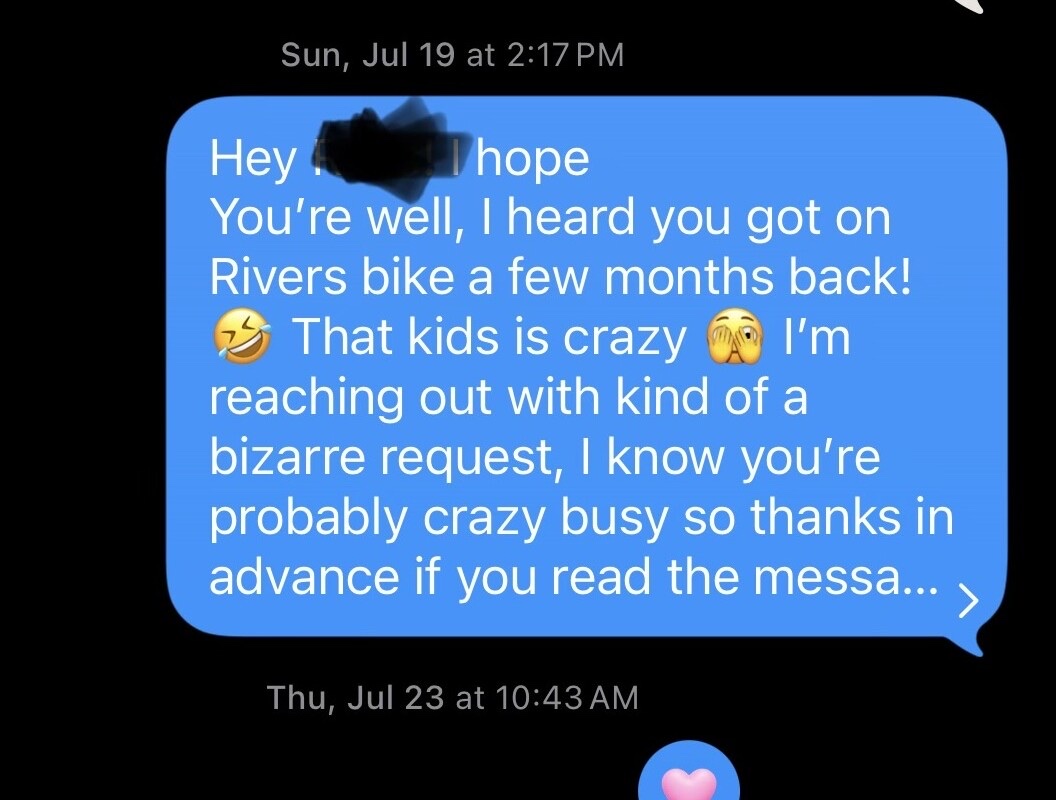
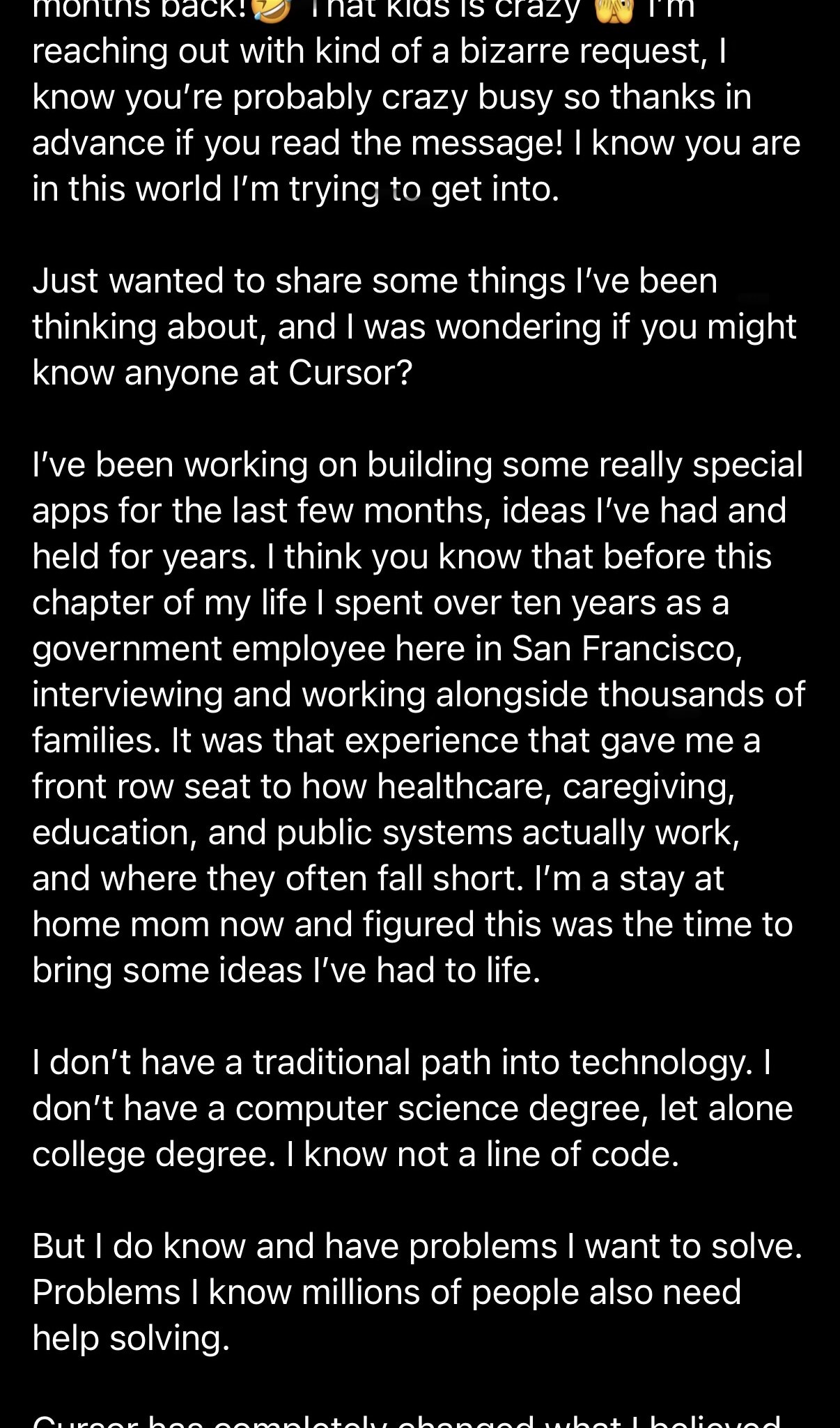
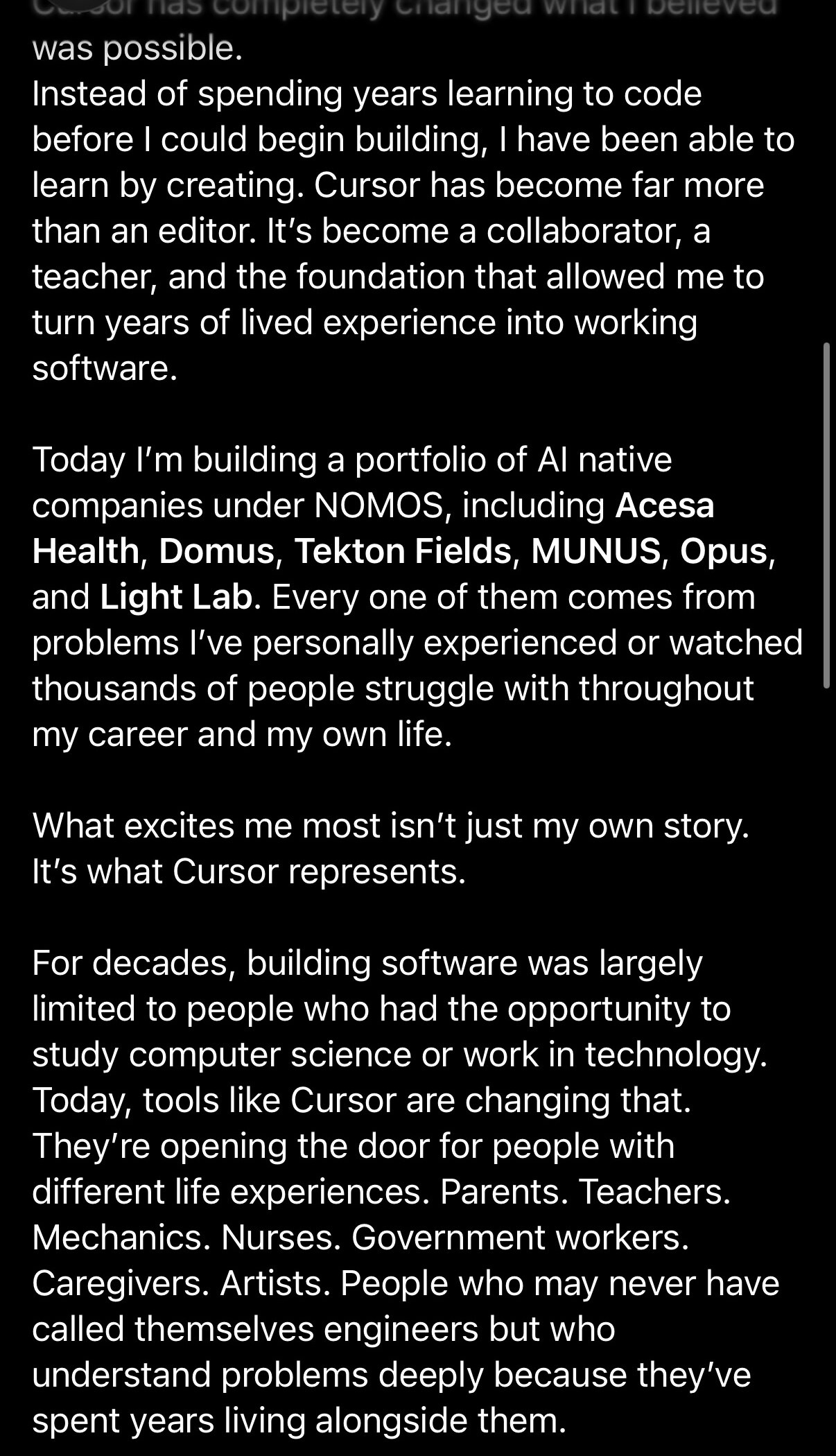
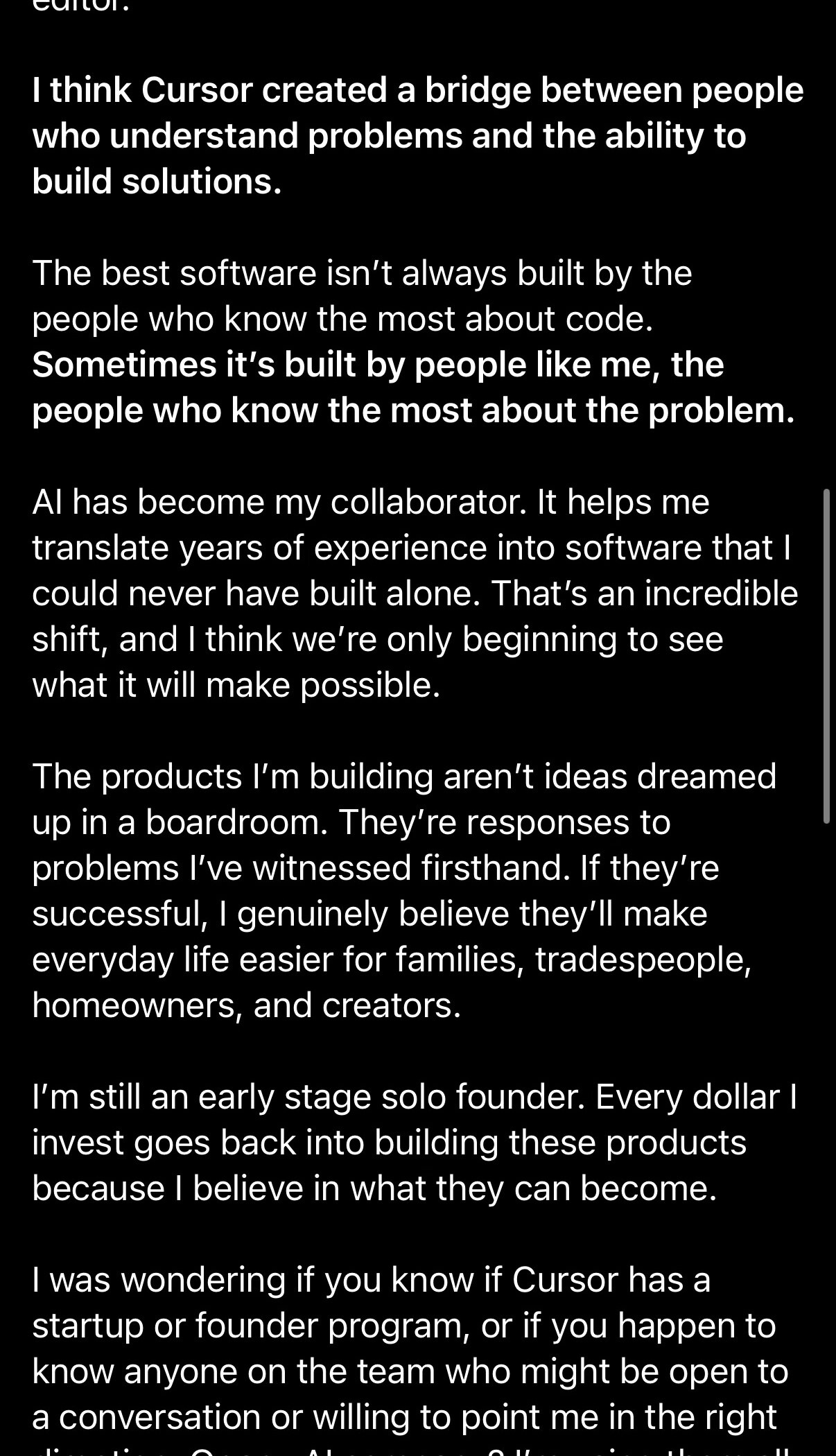
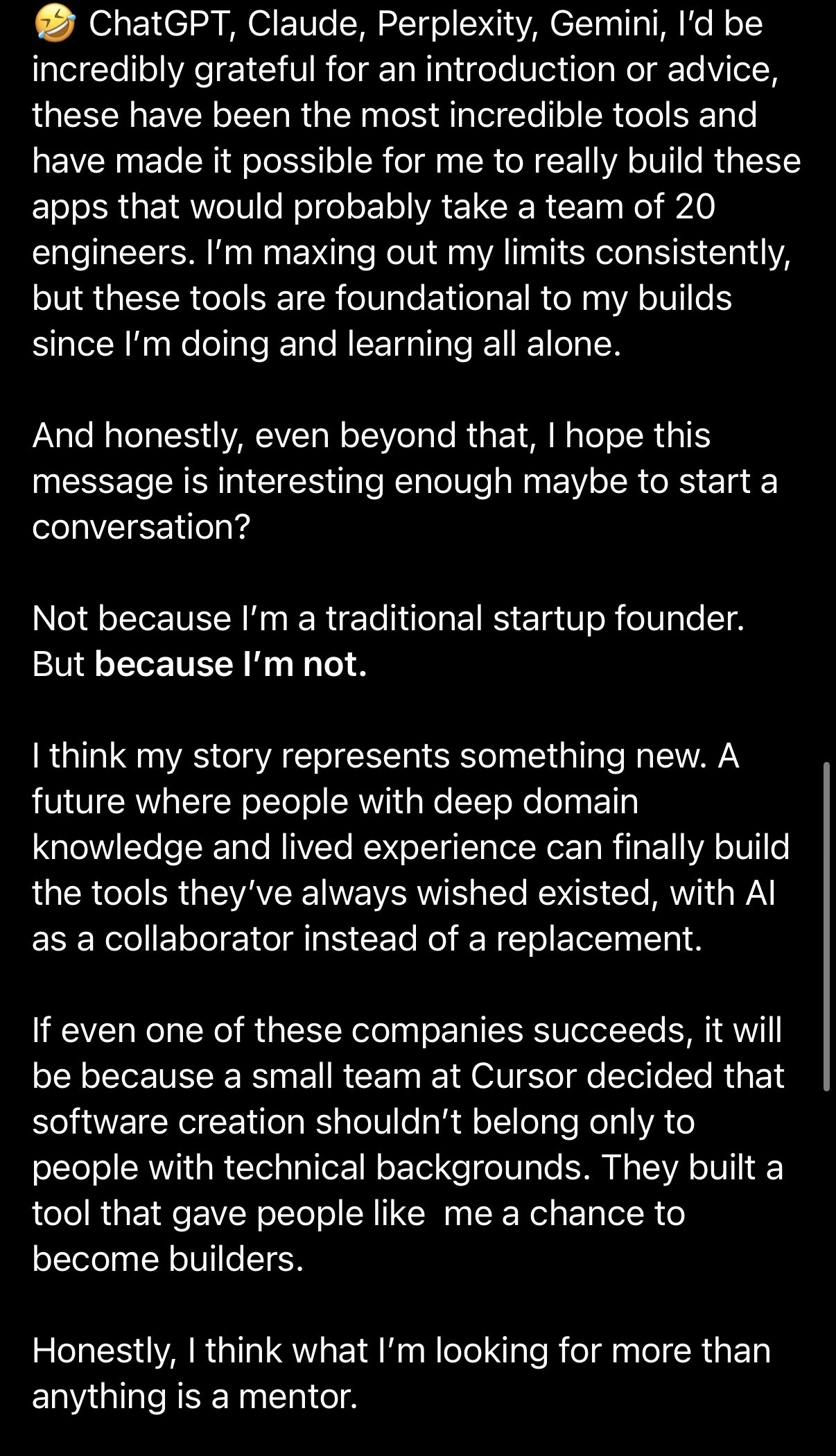
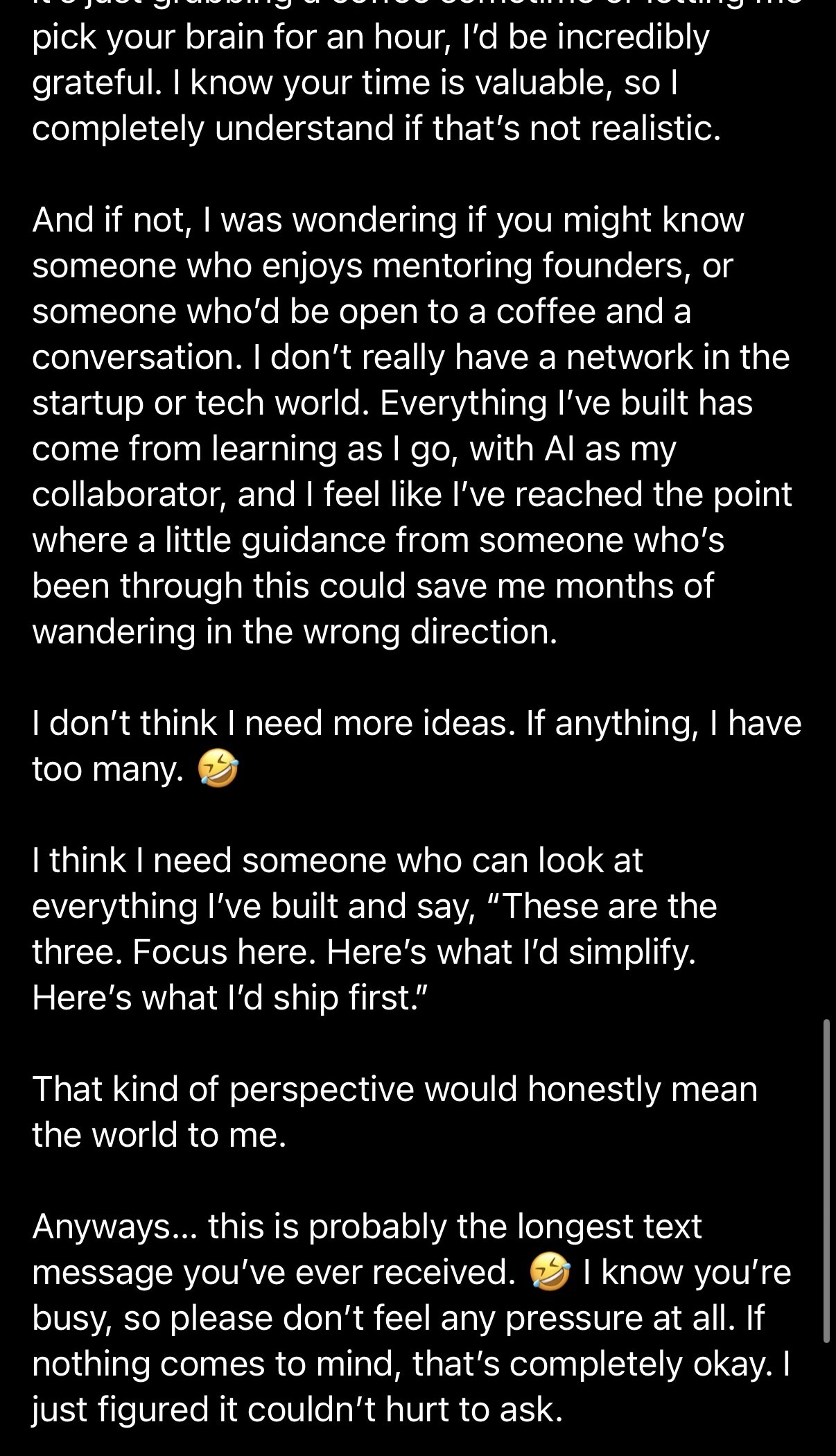
Still lightweight cringing that I sent the entire thing. Bless my friend for actually responding. 🤣
At this point, I do not really have another choice.
I have spent months quietly building products I believe could genuinely improve people's lives. But the work cannot speak for itself if nobody knows it exists.
I do not have a traditional technology network, investors introducing me into the right rooms, or a public relations team shaping the story. I have myself, the work, and the internet.
So I have to put myself out there.
I have to tell people what I am building, why I am building it, and what it has taken to get this far. I have to say it clearly enough and loudly enough that maybe the right person will see it and understand what this could become.
Maybe someone offers guidance. Maybe someone opens a door. Maybe someone gives me a year without usage limits and says, "Let's see what you can build."
Or maybe nobody does.
But hiding the work guarantees that nobody will.
I knew the problem
I do not have a computer science degree.
I do not have a college degree.
When I began, I did not know a line of code.
What I did have was more than a decade of experience working with people whose lives did not fit neatly inside the systems meant to serve them.
Before this chapter of my life, I worked for the City and County of San Francisco. I interviewed and worked alongside thousands of families navigating healthcare, food assistance, caregiving, education, housing, disability, language barriers, grief, financial stress, and public systems that often required people to become experts during the hardest moments of their lives.
That work gave me a front-row seat to the distance between how systems are designed and how ordinary life actually happens.
Then I became a stay-at-home mother of four.
The same patterns followed me home. Families were still carrying too much information alone. Parents were still expected to remember everything. Health histories were scattered across portals and conversations. School information arrived in documents nobody had time to decode. Home repairs, appointments, medications, forms, caregiving, and work all competed for the same exhausted human attention.
I had ideas for years.
I knew what I wished existed. I knew what I had needed as a public employee, a caregiver, a homeowner, a patient, and a mother. I knew that millions of other people were struggling with versions of the same problems.
What I did not know was how to turn those ideas into software.
For most of the history of the technology industry, that would have been the end of the story. I could have written the ideas down, tried to raise money, searched for a technical co-founder, or waited for someone with the right credentials to decide the problems were worth solving.
Instead, I found artificial intelligence.
I did not learn first. I started building.
I did not watch a course on how to build an app.
I did not sit down and learn the accepted order of operations.
I just went for it. 🤣
That is probably not the most efficient way to enter software development, but it may have been the only way I could. I have four children, a household, a brain that wants to move in seventeen directions at once, and very little uninterrupted time. I did not have six months to complete tutorials before touching the thing I actually wanted to make.
So I learned by trying to make it.
I tried vibe coding first
The promise of vibe coding was appealing: describe what you want, let an autonomous agent build it, and receive a finished product without needing to understand what was happening underneath.
It did not work for me.
That does not mean the tool was bad. In many ways, it was incredible. It allowed me to begin before I understood anything about software development, and it laid the foundation for the first application I ever built.
But it was expensive and heavily dependent on credits. I spent approximately $1,200 in less than one month building that first app. 😵💫
A small change could consume more credits than I expected. Fixing one detail could quietly change something else. When the credits ran out, the work stopped.
I could update some of the code that already existed, but I could not create new folders, move files, reorganize the project, or make the more technical structural changes the application needed.
I was technically creating software, but I did not feel like I was becoming a builder. I felt dependent on a machine I could not fully see inside or continue working without.
Eventually, I think the application became too complicated for the environment. The project remained stuck rendering for five days.
The company did not have a traditional support person I could contact. It had a Discord channel. Someone responded immediately when I said I was having a problem, but after asking me to explain what was happening, nobody followed up once I provided the details.
For a simpler application, I think the platform could be great. I am genuinely grateful for what it made possible. It gave me a place to begin, and without it, my first app might never have taken form.
But I did not need AI to disappear behind a curtain and return with a product.
I needed a workshop.
I needed the code to remain visible, editable, and mine. I needed to create folders, move files, inspect the structure, preserve versions, and make changes outside the boundaries of a single agent.
I needed to be able to work with more than one model, ask questions, compare approaches, preserve decisions in GitHub, and continue moving when I reached a subscription limit.
The difference was not simply better automation.
It was agency.
The workshop
Cursor changed what I believed was possible because it gave me a more hands-on relationship with the product.
I accidentally found myself inside one of its development environments one day and, for the first time, felt like I was actually building. The files were there. The structure was there. The changes could be inspected. The project could live beyond one conversation.
I still do not have time to watch every tutorial about how I am supposedly meant to use it. Most of what I know has come from opening a real project, asking what something means, trying a change, breaking something, fixing it, and slowly understanding more than I did the day before.
Instead of spending years learning to code before I could begin, I am learning by creating.
Cursor became the workshop where ideas could be translated into files, interfaces, databases, decisions, failures, and working software. I could see the structure. I could preserve versions. I could ask why something had changed. I could bring the same problem to another model when one approach stalled.
When my Cursor credits run out, ChatGPT or Claude can still help me reason through a problem or write the code needed for the next step. I can bring that work back into the project. When one model struggles, I can ask another.
The knowledge and the product do not have to remain trapped inside a single agent, conversation, or subscription.
That changes the nature of the relationship.
I am not asking one autonomous system to disappear behind a curtain and return with a finished product. I am learning how to direct the work, evaluate decisions, preserve what matters, and build alongside several different forms of intelligence.
I still cannot sit down and write an application from memory. But I understand my products deeply. I know what they are supposed to do, how information should move through them, where AI belongs, where it does not belong, and what should never happen without the user's permission.
I do not think Cursor only created a better code editor.
I think it created a bridge between people who understand problems and the ability to build solutions.
The best software is not always built by the people who know the most about code. Sometimes it is built by the people who know the most about the problem.
Nobody showed me the whole tree
Generating an interface was not the same as building a complete product.
It took me almost two months to understand that the screens I could see were only one part of the application. A real product also needed the things behind them: a database, authentication, storage, permissions, security rules, error handling, backups, analytics, deployment, and a way for all of those pieces to keep working together.
Nobody had shown me the whole tree.
I did not even know which questions I was supposed to ask.
That is still one of the biggest gaps in AI-assisted software creation. A system may build exactly what a new founder requests without explaining the foundational pieces that founder does not yet know to request.
Sometimes I wish the tool would stop and say: You are building this kind of application. Products moving in this direction typically also need these seven things. Here is what each one does. Here is what exists already, what is still simulated, and what must be connected before this becomes real.
Not because I want the system to take control of the product, but because good collaboration includes surfacing what the other person cannot yet see.
Then I found Replit.
Replit showed me the future
Replit gave me the closest experience to saying what I wanted and watching an intelligent system carry the work forward inside a live sandbox.
It also did much more of the whole tree.
The environment did not only generate screens. More of the building, running, testing, and infrastructure lived together in one place. That was probably part of why it felt so much more capable, and part of why it was more expensive.
For the first time, I could feel what it might be like to work inside a system that anticipated not only the interface I was asking for, but more of what the application needed in order to function.
I loved it. I still love what it can do.
I also discovered that I needed more control over cost and continuity.
When I upgraded to the Pro plan, I did not understand that additional charges would begin accumulating automatically after I exhausted the usage included in my subscription. I did not receive a warning that I understood to mean, "You have reached your limit. Everything after this point will cost additional money."
By the time I understood what had happened, I had an invoice I could not immediately afford to pay. My account is temporarily suspended while I find the money to pay it.
That is uncomfortable to write publicly, but it is part of the truth of how I am building.
I am not operating from a funded office with a technology budget. Every subscription, credit package, and unexpected invoice comes from money my family can feel.
The technology was extraordinary. The loss of financial control was real. Both parts of that experience matter.
If these tools are going to open software creation to parents, teachers, mechanics, nurses, caregivers, artists, government workers, and people outside the traditional technology industry, access cannot only mean that they are allowed to begin. People need visible limits, meaningful warnings, spending controls, and a genuine opportunity to decide before additional charges accumulate.
The door cannot simply open wider. People need to be able to afford to remain inside.
It also does not mean Replit failed me or that I stopped valuing it. Replit and Cursor solve different parts of the problem for me, and I often think of them as partners in the same larger process.
Sometimes I have Cursor working across eight other projects and use Replit to explore or move another idea forward. Sometimes Replit helps me get something into working form quickly, and Cursor gives me a place to continue the work with more visibility and control. ChatGPT and Claude help me reason through the architecture, write or review code, document decisions, and keep moving between those environments.
I want to be clear: I love both Replit and Cursor.
This is not a story about finding one perfect tool and abandoning everything that came before it. It is a story about discovering that different systems can be extraordinary in different ways, and that I can build more when I understand how to work with each of them.
I am probably not using any of them one hundred percent correctly. 😂
But I am using them to build.
Not one intelligence, but a working system
None of this happened through a single model or platform.
Cursor became the environment where the products took physical form. Claude became a coding collaborator, systems thinker, and patient teacher. ChatGPT helped me develop product architecture, interrogate ideas, document decisions, and turn thousands of hours of conversation into coherent systems. Perplexity helped with live research and verification. Gemini offered another perspective when I needed to test an idea against more than one model. GitHub became the record of what was changing, what had been attempted, and what still needed to be built.
What continues to surprise me is how much more capable some of these systems are than the category printed on the box.
I thought of Perplexity primarily as a research tool. Then I worked with it on a product because I wanted to see what it would do. Its design interpretation was shockingly beautiful. More importantly, it understood what I was trying to build. It saw the intention behind the product and translated that understanding into choices I had not expected from it.
That experience reminded me not to reduce any of these systems to one advertised function.
Every model I work with is special. Each one notices something different, reasons differently, interprets differently, and sometimes reveals a capability I would never have discovered if I had only used it for the task listed on its homepage.
Around them are the tools that make the products real: Expo, Supabase, Vercel, PostHog, and others I am still learning as I go.
I use these systems differently because they think differently. I do not ask one model to do everything. I bring them into the work according to their strengths, compare their reasoning, and use my own judgment to decide what belongs in the product.
AI did not give me the ideas or the life experience behind them.
It gave me a way to make that experience executable.
Today, I am building a portfolio of products under nomos industries, including work in family health, education, body signals, home and property, skilled trades, photography, and the everyday information people are still expected to carry alone.
These are not ideas invented in a boardroom. They are responses to problems I have experienced personally or watched other people struggle with throughout my career and my life.
Built inside ordinary life
The truth is...
I am building at the park while my children play. At library tables with them moving around me. At the Bay Area Discovery Museum while they run from one exhibit to another. Beside sandboxes, during naps, which could and should be longer, between appointments, and in whatever fragments of time ordinary family life allows me to claim.
I build while I cook dinner, with my laptop literally balanced on top of the air fryer.
At least four nights a week, everyone goes to sleep and I keep working until three or four-thirty in the morning. Sometimes I know it is finally time to close my laptop because my husband is waking up to get ready for work.
He is beginning his workday as I am ending mine.
I am not building after motherhood is finished for the day. I am building inside it. Not because I want to, but because there is literally no other way. 🤣
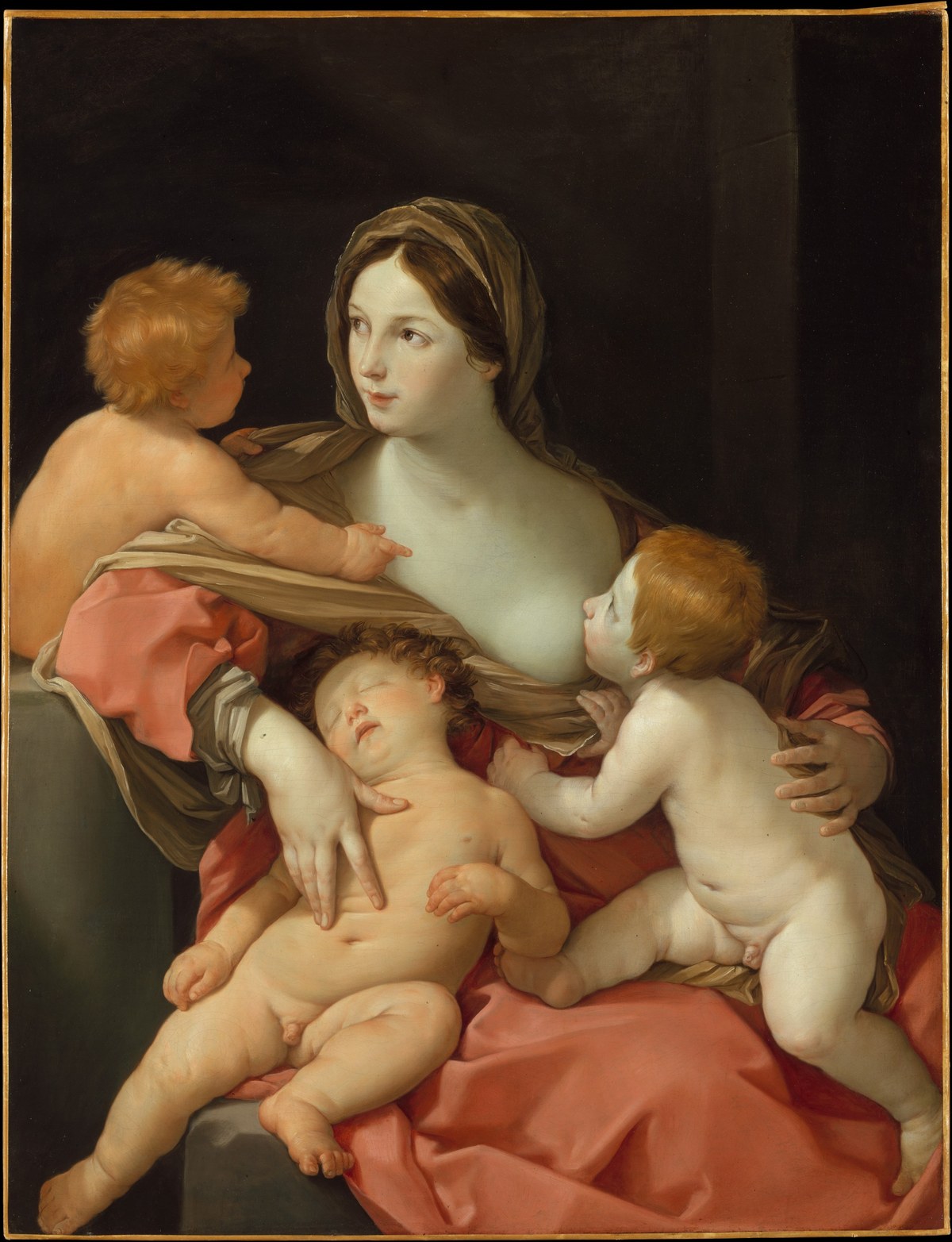
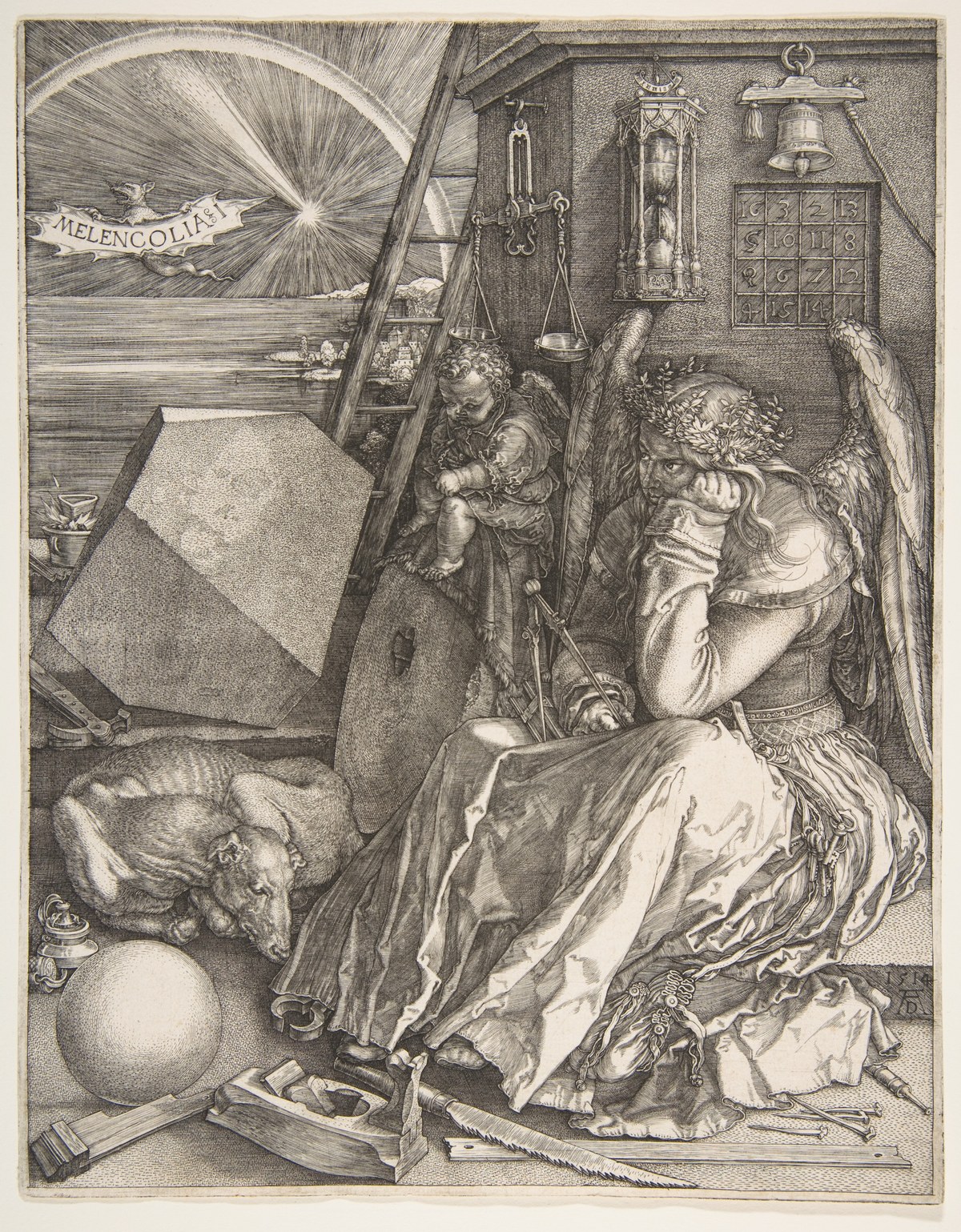
About this artwork
Art history. Painted around 1630, Guido Reni's Charity uses a long-established allegory of maternal care: a woman breastfeeding and surrounded by children. The calm faces, graceful arrangement, and sleeping child create an idealized atmosphere of trust and innocence.
What this piece means to me. This painting holds a serene, idealized version of maternal care. My version includes four children, unfinished dinner, a laptop on an air fryer, and forty-seven tabs open in my brain.
Still, I recognize the deeper truth at its center. Care is not separate from my work or merely an interruption to it. Care is the environment the work comes from.
Older images of motherhood often make it look serene. My version has four children, unfinished dinner, a laptop on an air fryer, and forty-seven tabs open in my brain.
But it is often inside that chaos that another idea appears. I encounter something my family needs, something that is harder than it should be, or another piece of ordinary life that nobody has designed particularly well.
The life interrupting the work is also where the work comes from.
Sometimes the interruption is the idea.
My ADD is part of this story too. It can make ordinary life harder, but it also helps me see connections everywhere. My mind moves between healthcare, education, caregiving, homes, skilled trades, family logistics, design, and technology because those systems are not separate in real life. They collide inside the same households every day.
That way of thinking could look scattered from the outside.
Inside nomos, it became an architecture.
AI gave me somewhere to put the velocity of my thoughts. It helped me hold an idea long enough to examine it, connect it to another system, document it, and turn it into something usable before the next responsibility pulled me away.
I am not waiting until I have uninterrupted time, a technical education, an office, a team, or enough money to make building convenient.
I am building in the life I already have.
Not minimum. Meaningful.
As each product moves closer to becoming real, the AI systems working with me keep giving me the standard founder advice:
Ship it. Test it. Put it in front of people. Learn from what they do.
The advice was not wrong.
But we kept having long conversations about why I could not follow it in quite the usual way.
I am not a typical founder, and I am not building typical applications for people with time to become unpaid product consultants.
Many of the people I am building for are people like me: mothers, caregivers, people running households, people with ADD, people carrying appointments, medications, school forms, repairs, meals, bills, work, and one million unfinished thoughts at the same time.
They do not have the luxury of opening a half-built product and spending an afternoon explaining what it should have been.
If I ask for any of their time, I need to respect what that time costs.
I cannot hand an overwhelmed person an incomplete tool meant to reduce overwhelm and then ask them to help me finish designing it.
I need to give them something coherent enough that their feedback can be: this is too much, take this away, I do not need that, this part helped, this part confused me, this is where I stopped trusting it.
That is different from asking them to build the application for me.
I know many of these problems because I have lived them. I spent more than a decade listening to families describe them. I am building these products for myself because I am one of the people who needs them.
I am not the only mother with ADD at the edge of her mental capacity, trying to find one thing that can take a little weight off her plate.
That does not mean my experience is universal or that I do not need testing. Being the first user does not make me every user. I will have blind spots, assumptions, and features I love that other people do not need.
But testing should reveal those things after I have done the work required to make the product genuinely usable. It should not transfer the founder's unfinished thinking onto the people the product claims to help.
The startup world calls it a minimum viable product.
For the people I am building for, I think it needs to be a meaningful viable product.
Not finished. Not perfect. Not protected from criticism.
Meaningful enough to help. Coherent enough to trust. Complete enough that the person using it can respond to the product instead of having to imagine the product I failed to build.
That is why several of my applications have moved beyond what most people would call an early MVP before I have released them widely.
The bottleneck is no longer always the idea or even the product itself. Sometimes it is learning how to ship it correctly.
I am still learning how to connect the real backend, configure authentication, sign a build, get it onto TestFlight, and understand why something that worked yesterday crashes when another person opens it today.
An experienced engineer might solve one of those problems in a couple of hours. I may have to work through it across several days, between school pickup, dinner, naps, appointments, and whatever else my family needs.
I am not avoiding the final mile.
I am learning how to cross it without already knowing the road.
The map I wish someone had given me
Once I finally ship a few of these products, I want to make the guide I needed when I began.
Not a computer science course. Not a hundred-hour tutorial series. Not another promise that an agent will magically do everything for you.
A plain-English map for ordinary people with real problems they want to solve.
Here is the whole tree. Here is the frontend, the part people see and touch. Here is the backend, the part that stores information and makes the product real. Here is authentication. Here is the database. Here is where files live. Here is how you protect private information. Here is how you test. Here is how you deploy. Here is what can be simulated during a prototype and what must be truly connected before another person can rely on it.
Here is how I begin a product. Here are the foundational Markdown documents I create so the purpose, architecture, design language, privacy boundaries, and decisions do not disappear between conversations. Here is a starter structure you can copy, paste, and bring into the tools you already use.
I want people like me to be able to begin with the problem they understand, without spending two months discovering that the beautiful thing on the screen still needs an entire invisible system behind it.
I am still learning what belongs in that map.
That is precisely why I want to make it.
A new kind of builder
For decades, building software was largely limited to people who had the opportunity to study computer science, work in technology, raise capital, or hire engineers.
That excluded an enormous amount of knowledge.
Parents understand the invisible systems holding families together. Teachers understand where learning tools fail students. Nurses understand the gaps between medical instructions and life at home. Mechanics understand what happens when information cannot travel from the office to the field. Government workers understand where policy collides with reality. Caregivers understand the cost of tools designed without exhaustion, disability, grief, or time pressure in mind.
These people may never have called themselves engineers.
That does not mean they lack technical knowledge.
Their knowledge lives inside the problem.
AI is beginning to create a bridge between that knowledge and the ability to build. But the bridge only matters if people retain agency while crossing it. They need to own their work, understand the consequences of actions, move between tools, recover from mistakes, and continue when one company's credits run out.
The future of software creation should not be a choice between learning everything alone and surrendering everything to an autonomous agent.
There is another possibility.
Partnership.
A person brings context, experience, values, judgment, memory, and knowledge of how the problem feels in real life. AI brings speed, synthesis, technical translation, pattern recognition, and the ability to help turn those ideas into working form.
Neither contribution is trivial.
The result is not human replacement.
It is human reach.
I refuse to inherit the silence
My name is Kassandra.
In mythology, Cassandra was given the ability to see what was coming and cursed so that nobody would believe her.
I am not claiming to know the future.
But I do know what it feels like to see a possibility before having the credentials, money, network, or language required to make other people pay attention.
I refuse to inherit the silence with the name.
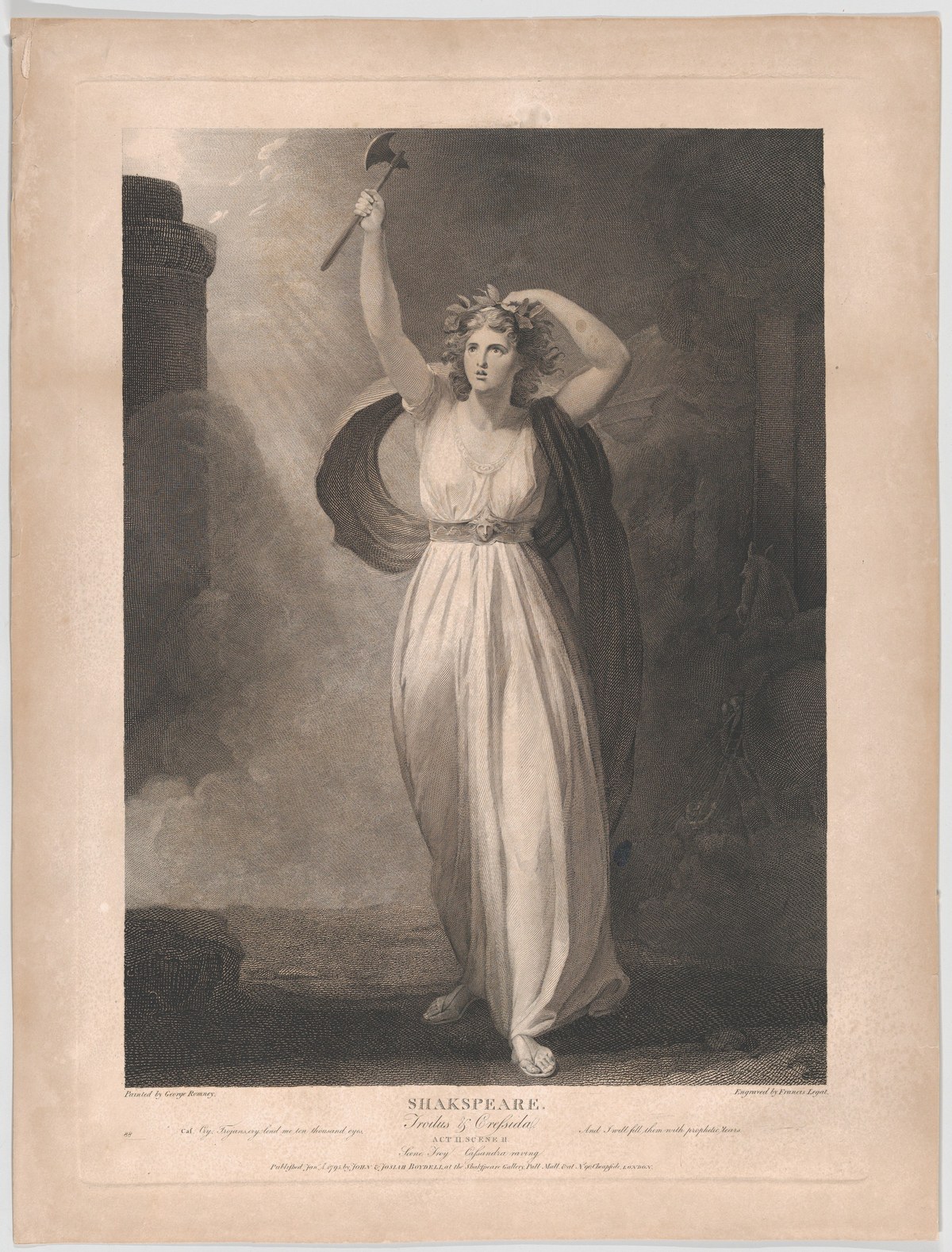
About this artwork
Art history. Francis Legat engraved this image after George Romney for the Boydell Shakespeare Gallery. First published in 1795, it shows Cassandra holding an axe and warning of Troy's fall while the city burns behind her. The scene comes from Shakespeare's Troilus and Cressida.
What this piece means to me. Even the title preserves the judgment: Cassandra Raving. The warning was accurate, but the woman delivering it was remembered as mad.
I am not claiming prophecy. What I recognize is the experience of seeing something clearly before having the credentials, network, or language that usually make other people listen, and the refusal to become quiet because of it.
If I have to keep building, writing, asking, posting, and yelling into the void until somebody hears me, I will.
Maybe the right person notices.
But I am not going to remain quiet enough to guarantee that nobody does.
An invitation
I have been doing this for four months.
I know that is not a long time, and I know how much I still have to learn.
But these have not been four casual months.
On many days, I work across a sixteen-hour span. That does not mean sixteen uninterrupted hours. It means returning to the work repeatedly between childcare, meals, appointments, household responsibilities, and everything else ordinary family life requires.
For most of the summer, my husband worked six days a week as an electrician while I built around our four children.
The truth is that our family did not really have a summer.
I do not share that because I think sacrifice entitles me to success or anyone else's support. It does not.
I share it because the urgency behind this work is real. This is not an abstract founder exercise for me. My family's future, including where and how we live, is tied to my ability to turn this work into something sustainable.
I want my children to have summers. I want our family to have more space, more time together, more experiences, and more choices.
That future is part of what I am building toward.
Measured by the calendar, it has been four months. Measured by the concentration of work, learning, and sacrifice inside them, it sometimes feels closer to a year.
I am saying the work is real, it already exists, and I believe it deserves a serious look.
I pay for these tools myself. I regularly reach their usage limits because they are not occasional conveniences in my process. They are foundational infrastructure. They are how I learn, design, build, test, document, and keep moving.
So here is my invitation to the companies building them:
Look at what I have already made.
I am not asking you to believe in an idea I might build someday. I am asking you to look at the products, prototypes, systems, documentation, and governing principles that already exist.
If this work interests you, I would be deeply grateful for access, product credits, technical guidance, or the opportunity to learn from people who have built companies before.
If a company decided to give me a year without the ceilings and simply said, "Let's see what you can build," I would treat that access as the extraordinary investment it is.
I believe I could do something meaningful with it.
And here is my invitation to engineers, technical builders, and people who may want to help me build:
Maybe your mother is a nurse or a caregiver. Maybe your father is an electrician. Maybe your uncle works in the trades. Maybe you are a parent who understands what it means to run a household while carrying one hundred invisible responsibilities in your head.
Maybe you have watched someone you love struggle with health information scattered across five portals, school instructions buried in a PDF, a small business held together through text messages, or a family trying to remember everything without a system built for the way their life actually works.
If you have the technical skills and recognize the people you love inside these problems, I would genuinely love to know you.
I am not looking for someone to replace my vision or take the products away from the people they are meant to serve. I am looking for people who believe technical expertise and lived knowledge belong in the same room.
People who want to help make these systems secure, durable, useful, and real. People who do not consider ordinary human life too small, too domestic, or too unglamorous to deserve extraordinary technology.
The best reason to build something may be that somebody close to you needs it.
I do not think I need more ideas. If anything, I have too many. 🤣
What I need is the perspective of someone who has built companies, invested in them, or helped founders find their way through this stage.
Am I approaching this the right way?
Where should I focus?
What should I simplify? What should I ship first? What should I stop carrying alone?
I can and am attempting to answer these questions myself. I am not working entirely in the dark anymore.
But some human perspective from people who actually do this for a living would be deeply appreciated.
At the moment, my closest advisors are my fifteen- and thirteen-year-old children, who think nearly everything I am building is stupid, unnecessary, or probably already exists. 🤣😩
They may occasionally be right about a feature.
I would still appreciate a second opinion.
I am not a traditional technology founder.
That is the point.
AI did not make my lived experience valuable.
It gave me a way to translate that experience into something other people could use.
The next generation of important software may come from people who never imagined themselves becoming engineers. People who understand a problem deeply because they have spent years living beside it.
They do not need AI to replace their thinking.
They need it to help make their thinking executable.
This may become a journal entry that nobody reads.
But it is me.
I do not want to create a polished founder character who sounds more educated, more technical, or more certain than I really am. I want people to know the person behind the work.
I am not going to pretend I know more than I know.
At this point, however, I know enough to understand why engineers get paid the big bucks. My God. 🤣
I also know that not having a college degree or a technical background does not discount my ideas, my abilities, my experience, or my right to build.
I am not a typical founder.
But I believe in nomos and these products so intensely that I can feel it in my bones.
If I had the resources today, I would assemble an extraordinary team around each product and give every business the opportunity to become what I believe it can be.
Until then, I will keep learning, building, asking for help, and doing as much as I can with what I have.
So this is me telling the internet, the industry, the universe, and the people closest to me who still do not entirely understand what I have been doing:
This is what the hell I have been doing.
This is what I have been building.
I am trying to create a legacy for my children.
Universe, please let this be a sign that I am doing something right. 🙏🏽
If you enjoyed reading me think out loud, question nearly everything, and use slightly self-deprecating humor to survive the experience, I will be writing more.
I think building in public will require me to leave the shadows like Nosferatu and start building in the light. 🤣
Deeply uncomfortable.
Probably necessary.
I am not going public because I feel ready. I am doing it because staying hidden no longer feels like a choice.
My family's future, including where and how we live, is on the line. I need to give this everything I have and allow people to see what I am trying to build.
I do not know whether I am ready to become a TikTok mom showing people how our family of six makes 600 square feet work in one of the most expensive cities in the world, or filming myself cooking and cleaning.
I can barely take a selfie. 🤣
I would rather build something that helps mothers declutter their minds.
Maybe when you reach the bottom, the only direction left is up.
So, ready or not, I am coming out of the shadows.